Brewing
Coffee Extraction: What Actually Ends Up in Your Cup
Coffee Extraction: What Actually Ends Up in Your Cup
You brew the same coffee twice. Same bean, same dose. Once it tastes sweet, round, balanced. The next time it is thin, sour, almost salty. Or bitter, sharp, dry. What happened ? The answer sits in one word: extraction. And once you understand how it works, you stop guessing and start brewing.
What extraction actually is
Hot water dissolves substances out of the ground coffee. Acids, sugars, aromatic oils, bitter compounds. A whole range of compounds, each with its own taste and its own dissolving speed. In the first seconds, the acids come out. Then the sweetness. Only towards the end do the bitter compounds release.
That is exactly what makes extraction a question of timing. Stop too early and the sweetness is missing. Let it run too long and the bitter compounds arrive. The art is to land somewhere in between.
The numbers behind it
The Specialty Coffee Association has been working with one simple metric since the 1950s. Researcher Ernest Earl Lockhart developed the Coffee Brewing Control Chart back then at MIT. That model is still the basis today.
Lockhart measured two values. First, the share of dissolved substances in the cup, what we call TDS for Total Dissolved Solids. Second, the share of the bean that has moved into the water, the extraction yield. His finding: between 18 and 22 percent extraction yield, coffee tastes best. Below 18 percent it is under-extracted. Above 22 percent over-extracted.
For TDS, the SCA defines a target range for filter coffee of 1.15 to 1.35 percent, the so-called Golden Cup Standard. If you brew at a ratio of 1 to 16, that is 60 grams of coffee per litre of water, you land mathematically right in that zone.
How under-extracted tastes
Sour, salty, thin. Sometimes a little like a green plant, often empty. The coffee feels watery on the tongue, body is missing. You are only picking up what dissolves fastest, which means the acids. The sweetness that normally rounds the picture out has not made it into the cup.
Typical causes: ground too coarse, brew time too short, water too cold, too little agitation in the filter.
How over-extracted tastes
Bitter, sharp, dry. An astringent feeling, similar to biting into an unripe banana. The coffee lingers in the mouth, leaves a scratchy aftertaste. Here you have the opposite: water had too much time and pulled out too many bitter compounds.
Typical causes: ground too fine, brew time too long, water too hot, too much agitation.
The four levers
You have four tools to control extraction. People who only turn one of them often get stuck. People who know all four are in charge.
Grind size. Grinding finer means more surface area, which means more extraction. Too fine and you quickly land in bitter territory. Too coarse and the water runs through too fast.
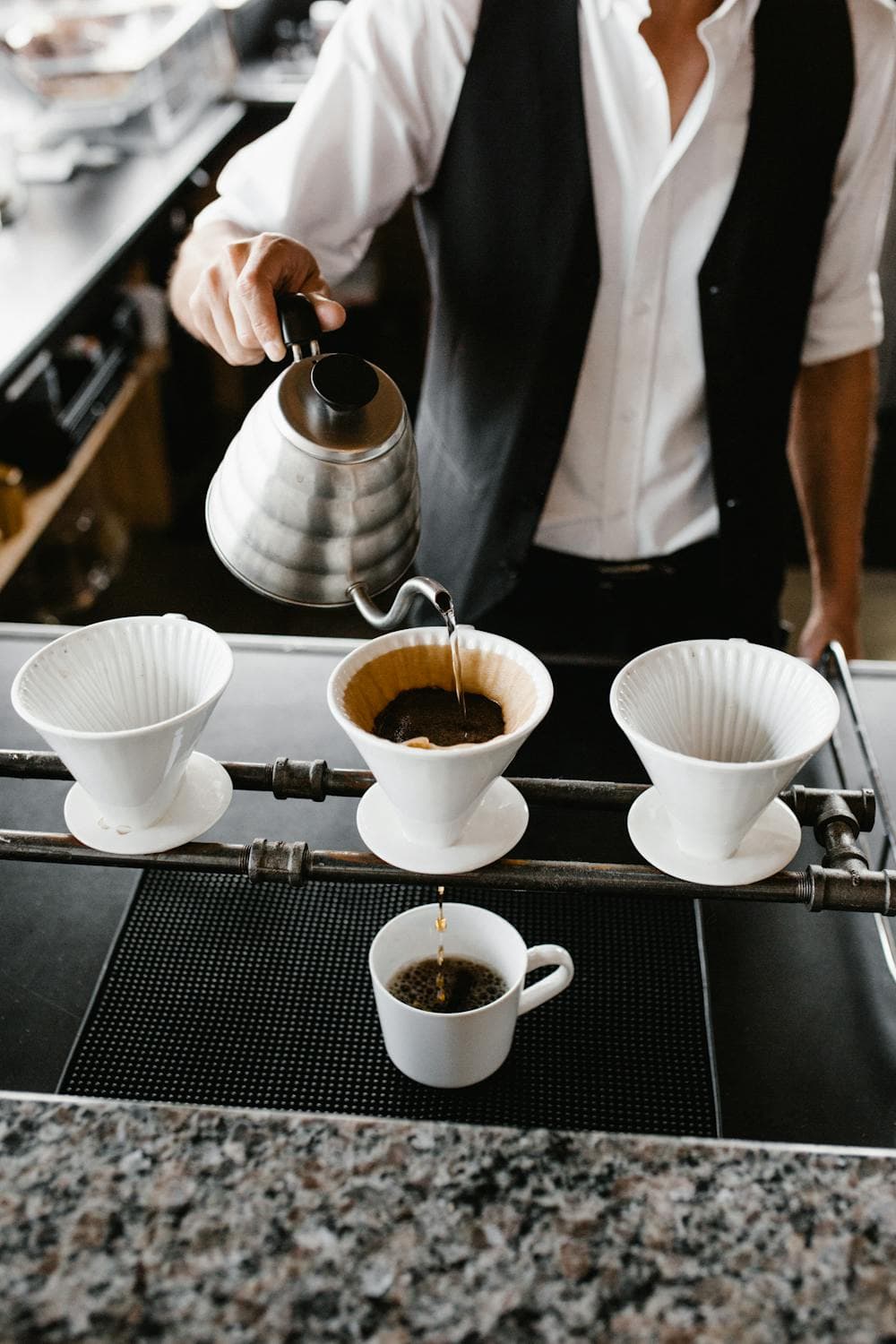
Time. Longer brew time pulls more out of the coffee. For pour over, three to four minutes is typical. For French press, four minutes. For espresso, 25 to 30 seconds.
Temperature. The SCA recommends 90.5 to 96 degrees. Too cold and you under-extract, the coffee stays sour. Too hot and you scorch the coffee, it turns bitter.
Ratio. More water per gram of coffee means a weaker cup, but higher extraction, because the water has more time to dissolve compounds. 1 to 16 is the filter standard.
How to use this in your kitchen
You do not need a TDS refractometer. You need a scale and a timer. If your coffee tastes sour and thin, grind finer or extend the brew time. If it tastes bitter and harsh, grind coarser or shorten the time. Change only one thing at a time and taste again.
After three or four attempts you start to feel how your specific combination of grinder, filter and water reacts. From there, brewing is no longer luck, it is craft.
What we keep in mind at Röstpost
Every coffee asks for a different treatment. A bright, dense Ethiopian bean dissolves differently than a soft Brazilian espresso. That is why most specialty coffees come with a recommendation for ratio and grind size on the bag. Start there and adjust by taste.
On Röstpost you find beans from more than two hundred Swiss roasters, bright filter coffees and strong espressos. People who play through grind and time on a single bean learn more about coffee than from ten new varieties.