Brewing
Chemex: the 1941 glass carafe still ruling specialty bars today
Chemex: the 1941 glass carafe still ruling specialty bars today
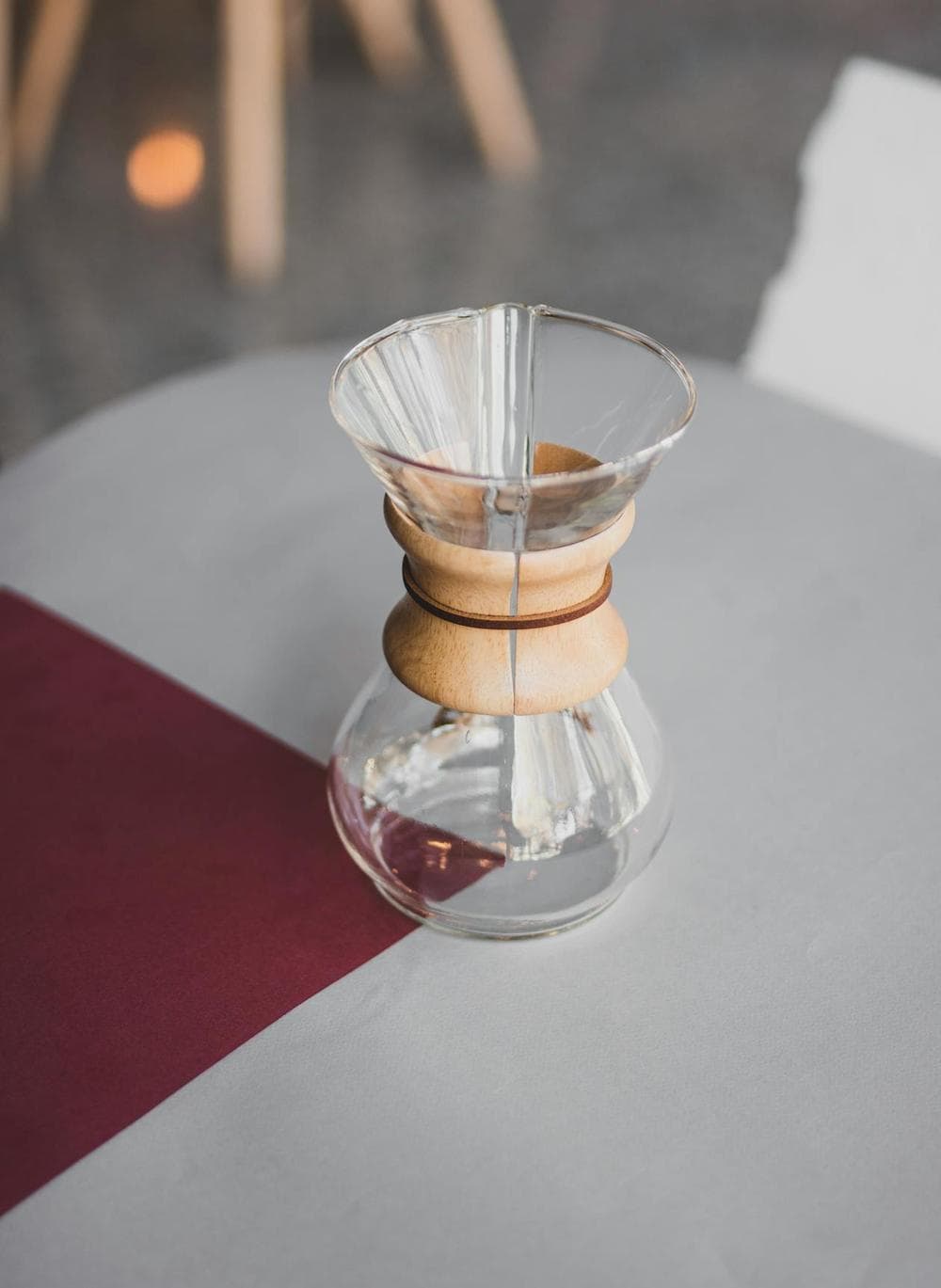
There are not many coffee devices on display at the Museum of Modern Art in New York. The Chemex is one of them. It is one of those few brewing methods you recognise just from its silhouette, even if you have never used one. A slim glass hourglass, a wooden collar, a little leather tie. Beautiful, simple, almost 85 years old and still found in every serious specialty bar.
A chemist builds a coffee pot
Peter Schlumbohm was a chemist. He came from Germany to the United States in 1936 and brought along more than a hundred patents. Most of his inventions were about glass, refrigeration and household tech. He filed the Chemex patent in 1939, it was granted in 1941. The Chemex was produced in Chicopee, Massachusetts, and it is still made there today.
The shape is no accident. Schlumbohm was inspired by the Erlenmeyer flask from the laboratory. Conical body, cylindrical neck. Borosilicate glass, the same glass used for test tubes. The wooden collar is not decoration, it is the handle: hot water makes the glass too hot to hold, and the wood protects the hand. The leather tie just holds the collar in place. Pure function, but so clearly thought through that it becomes beautiful.
Why it still works today
In 1958 designers at the Illinois Institute of Technology named the Chemex one of the hundred best designed products of modern times. It sits in the MoMA, the Smithsonian, and the Denver Art Museum. But that is not why it still sells. It still sells because it makes coffee that tastes different from anything else.
The trick is the filter. Chemex Bonded filters are 20 to 30 percent thicker than normal pour over paper. That is intentional. The thicker paper holds back oils and the finest coffee particles that slip through a V60 or a Melitta filter. Result: an extremely clean, transparent cup. Light body, lots of aroma, almost tea-like. If you love a clean, bright cup, you are home. If you love body and oil, the French press is a better fit.
The classic versions
Chemex comes in several sizes, from the small 3-cup version (around 450 ml) to the big 10-cup (around 1.5 litres). The two most useful are the 6-cup for at home, when two or three people are brewing, and the 8-cup when the whole kitchen wants coffee. There is also the Hand Blown series, mouth-blown, a touch fancier looking, but functionally identical.
The filter choice is simple: pre-folded squares (the original), circles, half moons, bleached (white) or unbleached (natural). Functionally it makes no difference. What matters is putting the paper in the right way around: the three-layer side goes against the spout, the single-layer side opposite. That keeps the water from running down behind the filter.
The Chemex recipe that actually works
You need: 30 grams of coffee, 500 grams of water, a 6-cup Chemex, a bonded filter, a grinder, a gooseneck kettle, a scale, and ideally a timer. That is a 1:16.66 ratio, roughly 1:17. For lighter roasts you can stretch to 1:18, for darker pull back toward 1:15.
Grind: medium coarse, around the size of sea salt. Coarser than V60. Water temperature: 92 to 96 degrees Celsius. If your kettle has no temperature control, boil and wait one minute.
Place the filter, rinse with hot water. That washes out the paper taste and warms the carafe. Tip the rinse water out. Add the coffee, press a small dent in the middle.
At zero seconds, pour 60 grams of water in slow circles until everything is wet. Swirl gently to settle the bed. Wait 45 seconds for the bloom. You see the coffee release CO2 and puff up.
At 45 seconds, continue pouring in waves. First wave up to 250 grams. At about 1:30, pour again up to 500 grams. The last pour should be done by around 2:30. The whole brew runs through in 4 to 5 minutes. If it is much slower, your grind is too fine. If it is much faster, too coarse.
The most common mistakes
Grind too fine: water sits forever in the filter, coffee turns bitter and over-extracted. Classic beginner trap, because many people just copy their V60 grind. Go a touch coarser.
Filter not rinsed: the first cup tastes like cardboard. Always rinse, always.
Wrong filter side: if the single-layer side is toward the spout, water can run down the glass instead of through the coffee. The result is a weak, watery cup. Three layers go against the spout, always.
Too little coffee: many beginners use 20 grams and fill up to 500 grams of water. That is too thin. 1:17 is an honest lower limit. Better a touch stronger than thin and washed out.
The beans the Chemex loves
The Chemex is a bright amplifier. It shows every note, mercilessly. Light specialty roasts from Ethiopia, Kenya, or Colombia work brilliantly. Floral, fruity profiles get the stage they deserve. A washed Yirgacheffe, a Geisha from Panama, a Burundi with blackberry. That is exactly what it is built for.
Medium light roasts also work, give more chocolate and caramel. Darker roasts go a bit flat in the Chemex, because the thick paper filters out the body. If you want espresso roasts, reach for a moka pot or a French press.
What else you need
A proper grinder is mandatory. Pre-ground coffee is flavour-dead within days, and the Chemex shows it instantly. A hand grinder is enough to start.
A gooseneck kettle helps because you can control the stream. A normal kettle and a steady hand also works, but it gets cleaner with a gooseneck.
A kitchen scale accurate to 0.1 grams. Without a scale you brew half blind and the result swings day to day.
What stays
The Chemex is slow. It is not efficient. The original costs around 60 francs, plus filters at around 15 francs per hundred. But it turns the morning coffee into a four minute ritual where you do nothing but pour water and watch. That is not a loss, it is a gain. On Röstpost you find exactly the bright specialty roasts from Swiss roasteries the Chemex was built for. Try a washed Ethiopian or a Colombian honey, then you understand why this carafe has been built for 85 years.