Brewing
The AeroPress: How a Frisbee Inventor Changed Coffee Brewing
The AeroPress: How a Frisbee Inventor Changed Coffee Brewing
In 2004, a retired engineer stood in his garage in California, frustrated with his coffee. Too sour from the filter. Too bitter from the machine. His name was Alan Adler, he had previously invented the Aerobie flying ring, and he decided he could fix this. Over thirty prototypes later, the AeroPress launched at Coffee Fest Seattle in November 2005. Today, more than five thousand baristas brew with it competitively each year.
How the Thing Works
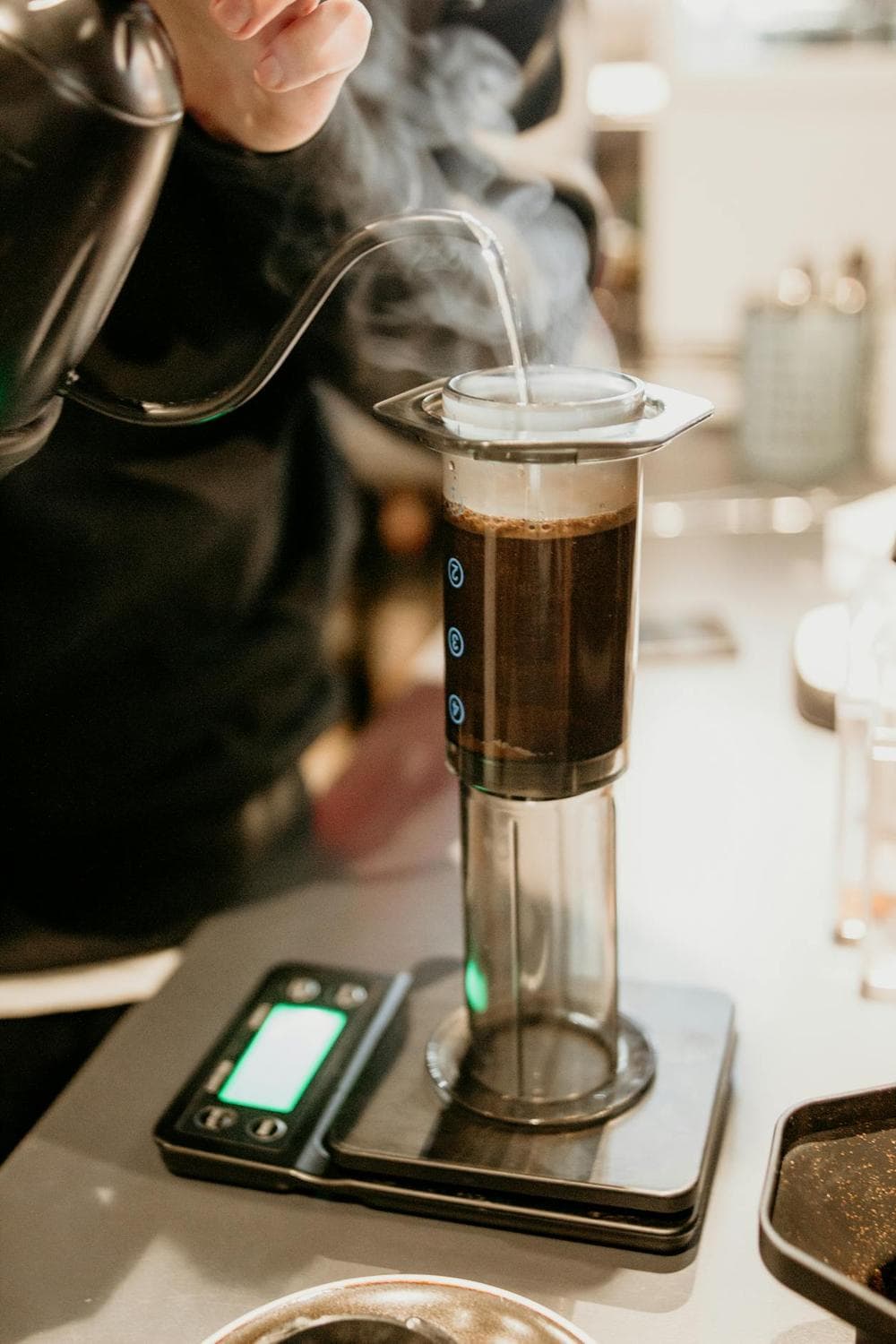
The AeroPress is a plastic tube with a plunger inside. You screw a filter into the bottom cap, drop in ground coffee, pour water on top, let it steep briefly, and slowly push the plunger down. Pressure pushes the water through the coffee, the grounds stay in the filter, the coffee ends up in the cup. From the first pour to the last drop, the whole thing usually takes between one and three minutes.
There are two schools of how to do this.
Standard or Inverted?
The standard method is what's in the manual. AeroPress with the filter at the bottom sitting directly on a cup, coffee in, water on top, let it steep, press. Fast, easy, good for the morning.
The inverted method was invented by coffee geeks, because in the standard method coffee starts dripping through the filter before you've even finished steeping. With the inverted method, the AeroPress sits on its plunger, open at the top, and you fill coffee and water into the chamber from above. Only when it's time to press do you flip the whole thing onto a cup. Full control over steep time.
In competitions today, almost everyone brews inverted.
A Recipe You Can Start With Today
The AeroPress is famous for the fact that every recipe is different. But everyone starts somewhere. Here's a baseline that works for most beans.
17 grams of coffee, medium grind (about like table salt), 250 grams of water at 92 degrees Celsius. That's a 1:14.7 ratio. With the standard method: AeroPress on the cup, filter in, grounds in, pour all the water in over fifteen seconds, let it steep for one minute, then press slowly over thirty seconds. Total: about one minute forty-five from start to finish.
Tastes bitter? Grind coarser. Tastes sour? Grind finer or steep longer.
The World AeroPress Championship
In 2008, three friends met up in Oslo to find out who could make the best coffee with an AeroPress. Tim Wendelboe, one of Norway's most famous roasters, was the judge. Anders Valde from Norway won. Today this has grown into a movement, with more than 120 national and regional competitions in over sixty countries and over five thousand competitors per year in total.
The rules are simple: maximum 18 grams of coffee, minimum 150 millilitres of finished coffee, five minutes of time, blind-tasted by three judges. What you do in those five minutes is your business. Some chill the water down to 75 degrees, others drop ice cubes directly into the brewing chamber, others stir with reverse motions. All allowed, as long as a genuine AeroPress is used in the end.
What the AeroPress Really Is (and Isn't)
The AeroPress is not espresso, despite what the marketing likes to claim. Real espresso needs nine bar of pressure; an AeroPress reaches at most one bar. What it makes is concentrated filter coffee, somewhere between pour over and French press. Cleaner than French press, because the paper filter catches oils and sediment. Fuller in body than pour over, because pressure pulls more out of the grounds.
It's small, sturdy, almost indestructible. Comes along on any camping trip. Doesn't need electricity. Cleans up in thirty seconds: cap off, push the plunger a bit further, and the coffee puck drops straight into the bin.
Why We Like It
A sampler box from the marketplace is made for the AeroPress. Small amounts, different beans, every cup becomes an experiment. Today a light roast from Ethiopia with the inverted method, tomorrow a Swiss espresso blend ground fine for a concentrated cup. You don't need a machine, you don't need a subscription to a system, you don't need expensive pods. Just the bean, the water, and a piece of plastic with a history.
On our marketplace you'll find coffees from over 200 Swiss roasteries. Many are particularly well suited to the AeroPress, because they're roasted light enough for their flavors to actually come through. Have fun pressing.